www.bettydanon.it
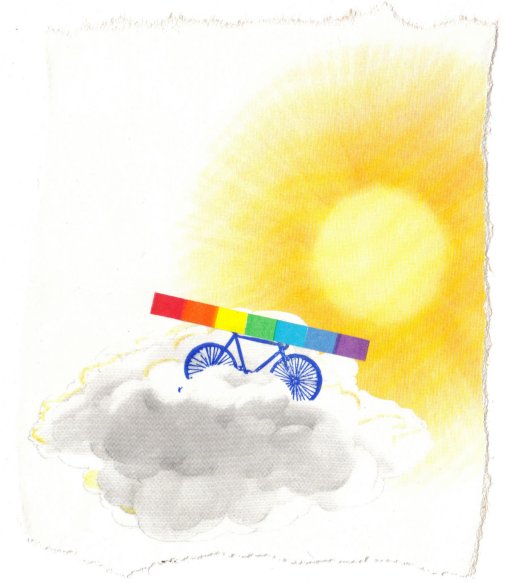
PERFORMANCE OVER CONI ZUGNA 37, 1980
BETTY DANON IN HER DAUGHTER’S RECOLLECTION
Recollecting Betty Danon as an artist means first of all talking
about her life and her way of living. Recollecting the person
means talking about her art and the way it changed
her and those who were close to her.
An impressionist painting can describe a landscape better
than a photograph by grasping its essence without revealing
its details. Therefore this book is not meant to give a precise
account of Betty Danon’s life and work, whereas it just tries to
suggest - through her own words and images - the scent of the
work and the message of a woman that was bold enough to
accept the call of art at the age of forty-two.
Art as an opportunity to cross the frontier of a conventional
conception of life, to give room to one’s hidden gift, to the
capacity of looking deep inside oneself, to the wish to venture
out in the boundless universe in search
of resounding dimensions.
From painting to collage, from graphic sign to performance,
from mail art to the use of computer, in the late ‘80s, definitely
in the lead, Betty Danon found her most congenial
environment in visual poetry: sound and sign, signifier and
meaning, playfulness and commitment, lonely workingthrough
and steady presence in a close net of international
relations were at the basis of an uninterrupted work that went
on for 33 years, from 1969 to 2002.
Driven by her Jungian inner analysis, she began her artistic
process playing with the yin yang theme, in a few years getting
to dot and line, upon which all her work and existential quest
were founded: in time they became particle and wave, the
foundation of the universe itself.
Once she got to the essential, after a year-long play with black
and white, her artistic journey became tinged with joy and
colour in Rainbowland, a huge stave-bridge made of air, water
and light collecting everybody’s “sounds”, as she used to say.
Here, the second Alice - no more in Wonderland
but in Rainbowland - would entertain visitors
with her zen-like questions.
From rainbow to Rimbaud, to whom she dedicated one of her
early visual poetry works, it was a short step, and by then she
had taken a run-up to rightly enter a world where poetry was
meant for the eyes, no longer for the ears, where writing could
become image and be treated as an object, where the artist
took possession of that space between illusion and reality and
where reading moved to different spheres beyond the
represented ones: ”what you mean to say is invariably
elsewhere, and that elsewhere at its best is like a
neverending wave”, the artist explained.
Betty Danon’s artistic production is remarkably wide, lots of
canvases dating back to the early ‘70s, collages, sculptures,
audio and videotapes of recorded performances, hundreds o
works on paper, more then 50 collections of visual poetry, a
few numbered printed copies, others printed in a limited
number, and other one-off items. Experts did show their
appreciation; after receiving the volume entitled “dot-line”, in
1976, Roland Barthes wrote her: “Quelque chose de très beau,
quelque chose de parfait…” (“Something so beautiful,
something so perfect…”).
A remarkable work in the whole collection is “Io & gli altri”
(The others & I) exibited in Galleria Apollinaire in Milano in
1979: more than 200 original works on music cardboard,
signed by some of the best known exponents of
contemporary art, such as Sol Lewitt, Nam June Paik, Ray
Johnson, Pablo Echaurren...
Born in Istanbul, Betty Danon moved out to Milan in 1956, and
exhibited her works in one-person as well as in collective
exhibitions in many European and oversea countries and took
part to two special exhibitions at the Venice Biennial, in 1978
and 1980. Her success, in the first twelve years of her activity,
was instant, unusual, but she was intolerant of any of the rules
imposed on artists by art galleries, and as she was lacking in
diplomatic talent and in the necessary supports to establish
herself in the Italian artistic scene, since the early ‘80s, for the
sake of her inner tranquillity, she decided to continue working
in the background, looking elsewhere for acknowledgement
and above all for an incitement to go on. She exclusively
turned to cultural circles free from speculations, such as
museums, libraries and archives, she increased her relations
with international sets, keeping in touch with American and
Australian mail art and visual poets who would be
close to her till the end of her life.
Rather than something to be exhibited, to Betty art became
more and more something to live and communicate,
something that could and should impregnate daily life and
lead people to discover and use the wide margin of freedom
and creativity life allows them to experience. So she started
keeping workshops – called at first “Exploring”, later on
“Harem” – to give people the opportunity to be creative for
the first time in their lives. Far from being the aim, working with
paper, words and colours was the means to create in the
group an atmosphere of sympathy, mutual respect and
warmth favouring the authentic communication with oneself
and the others we all need so much.
Turned into a small art museum, her flat situated on the third
floor in Viale Coni Zugna 37 was frequently visited by friends,
colleagues, foreign visitors, English students – “Learn English
singing along with Frank Sinatra and Betty Danon”, the
playbill of one of her activities reads -; while looking at the
walls of the rooms of her tiny flat you could plunge into a
cross-section of contemporary underground art.
Her mail-box soon became an important spot in her home.
There arrived the mail from artists and others from all over the
world, and there for fourteen years arrived the multicoloured
envelopes from the artist David Cole from New York, with
whom she exchanged playful letters and works, views, jokes
that helped her become familiar with the subtleties of the
English language. The complex unpredictable twisted
whimsical, sometimes thoroughly incomprehensible,
plays with words the two visual artists entertained each other with
one day will be the conoisseurs’ object of study and enjoyment.
Since 1989 her most faithful friend and tool was Toyfriend, the
small Macintosh “cube” with which she joined the computer
pioneers in the field of visual poetry. That would be followed
by Toyfriend2 and Toyfriend3, both Macintosh as well, to
which, in the memory of those who knew her,
she is indissolubly associated.
Hardly willing to get out of her reign and by no means keen on
travelling or society life, Betty used to be a reference point for
many, a precious friend, a wise counsellor. She answered
others’ existential complaints by quoting Baudrillard, inviting
them to get rid of stereotypes, clichés and simulacra; she
taught them to look into the mirror in the morning saying kind
words to themselves; she helped them see problems in their
right perspective catching a glimpse of the "light at the end of
the tunnel", always reminding people not to take themselves
too seriously; she used to keep the door open to the universe,
the great mystery she recognised,
though she never claimed to understand it.
Art became to her living authentically, joyfully, though being
aware of one’s limits, of objective difficulties, of time going by.
Indeed time went by, and she began to notice it. A dream set
her before a clock, she recognised it as a sign and turned it
into work, Tetrakis. She reorganized her archives, created
different anthologic copies of her visual poetry works, Pagine
dimenticate e non (Pages forgotten and not), and got in touch
with international archives. Her works are now in the “Museum
of Modern and Contemporary Art of Trento and Rovereto” -
where her archives are kept too -, in the “Museum of Modern
Art” of NewYork, in the Ohio State University Rare Books
department, in Sackner archives, in the museums and libraries
of about 25 nations all over the world.
When life gave her a clear sign of what her dream had announced her,
she did not worry about herself, she worried about her work on which a
prophecy weighed: “ It will be given acknowledgement when
you don’t care any more”. It was with this calm confidence that
she set on her journey to Rainbowland in April 2002, leaving
multicoloured rainbows to be scattered the world over.
In October 2004 Pulcinoelefante, art editions, took to New
York Art belongs to everyone, like the rainbow (L’arte è di tutti,
come l’arcobaleno). With one sentence Betty Danon makes
her message alive beyond time: “making art is being happy,
being free, loving life, making revolution”.
Marcella Danon
Osnago, October 2005
from Art as Life, Life as Art, Inventare il Mondo Editions, Osnago Lc-Italy, 2005
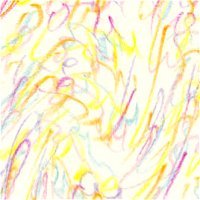
MULO MULO 1984
www.bettydanon.it